
AI arrived at your centre! Here’s a policy to consider
Somewhere in the last two years, AI would have walked into many ECEC centres, perhaps even yours. And often, it arrived in the form of an app or software update.
Today, childcare platforms offer high-powered AI features: they draft observations from photos, turn notes into learning stories, tag outcomes against the EYLF, build rosters, and answer parent billing queries overnight. If your service uses a management platform, there is a reasonable chance an AI feature is sitting inside it right now.
Most services have a photography policy, a privacy policy, and (since 1 September 2025) a digital technologies and online environments policy that Regulation 168 now requires. Almost none have a policy that answers the new questions surrounding AI. Can an educator paste an observation into ChatGPT to tidy the wording? Can an AI be used to draft a learning story from a photo of a child? Or can it draft a story, even just from some quick notes of a child’s day? Who checks it? Who is accountable for it? What did families actually agree to?
So we wrote one. Today, we’re releasing a free, adoptable AI Policy and Governance Framework for early childhood education and care services. Take it, review it carefully, put your service's name on it, and make it yours.
Why AI needs its own policy
Technology has a place in education. But it needs to be safe for children and their families. AI is no exception: used well, it can hand educators back precious time. That time belongs with children.
But AI is able to process the most sensitive material your service holds: children's photos, names, developmental notes, family details. And new features enabled by AI arrive faster than policies can follow. A vendor ships an update, a button appears, and an educator under documentation pressure clicks it. No assessment happened. No family was asked. Nobody decided; it just did what it was told to do. But many things might happen invisibly, behind that button click, that aren’t desirable, perhaps even unlawful.
The regulators have started to respond. The NSW regulatory authority has told services that AI-generated documentation must reflect actual practice at the service, and that authorised officers will test whether it does. The OAIC has warned organisations against entering personal information (especially sensitive information) into public generative AI tools, and reminded them that AI-generated content about a person counts as a collection of personal information under the Privacy Act. The Commonwealth's Voluntary AI Safety Standard sets out guardrails on human oversight, transparency, and risk management. And the Australian Children's Online Privacy Code, due for registration by 10 December 2026, will raise the bar for every platform that handles children's data.
None of that, on its own, tells your service what to do with AI, and how to do it. That is what a policy is for.
What our policy template covers
We’ve built this template around five principles that we feel matter most: children's interests come first, a human is always responsible, documentation reflects real practice, data minimisation, and transparency with families. From those principles it gets specific.
This policy permits AI-assisted drafting of observations and learning stories (but under conditions). The educator who was there reviews, corrects, and approves every output. AI drafts; educators decide. Accountability never transfers to a product.
It prohibits the uses that should never reach children: facial recognition and biometric identification, emotion recognition, AI-generated or AI-altered images of children, automated decisions about enrolment or development, and entering identifying information about any child, family, or staff member into public AI tools.
It gives you a simple, accessible governance machinery that’s sized for a childcare service: an assessment checklist to complete before a tool is approved, an AI register families can ask to see, and a standing rule that a new AI feature is unapproved until someone has looked at it. It also gives you the vendor questions that matter: where data is stored, whether it trains AI models, and what happens to it when a child leaves. That last question is not hypothetical. Our research has shown that very few childcare and school platforms have deliberate data deletion practices in place.
And it includes plain-language wording you can hand to families, because transparency is important and it must be read and understood by parents.
What to do this week
Download our template below. Open the settings of your management platform and list every AI feature you find. That list is step one of your register. Ask your vendor the questions in Appendix A, in writing. Then share and adapt the policy with your team; AI is a hot topic, everyone has opinions, and these opinions are important: a policy that your educators helped shape is one they will follow.
Your educators handle some of the most sensitive data in any sector. They deserve a clear answer to “am I allowed to use this tool or feature?” And families deserve to know what the answer is.
Get the policy template!
Click the link below and download our policy template. We made it so that it’s easily understood and edited by you and your team, but let us know if you need a hand.
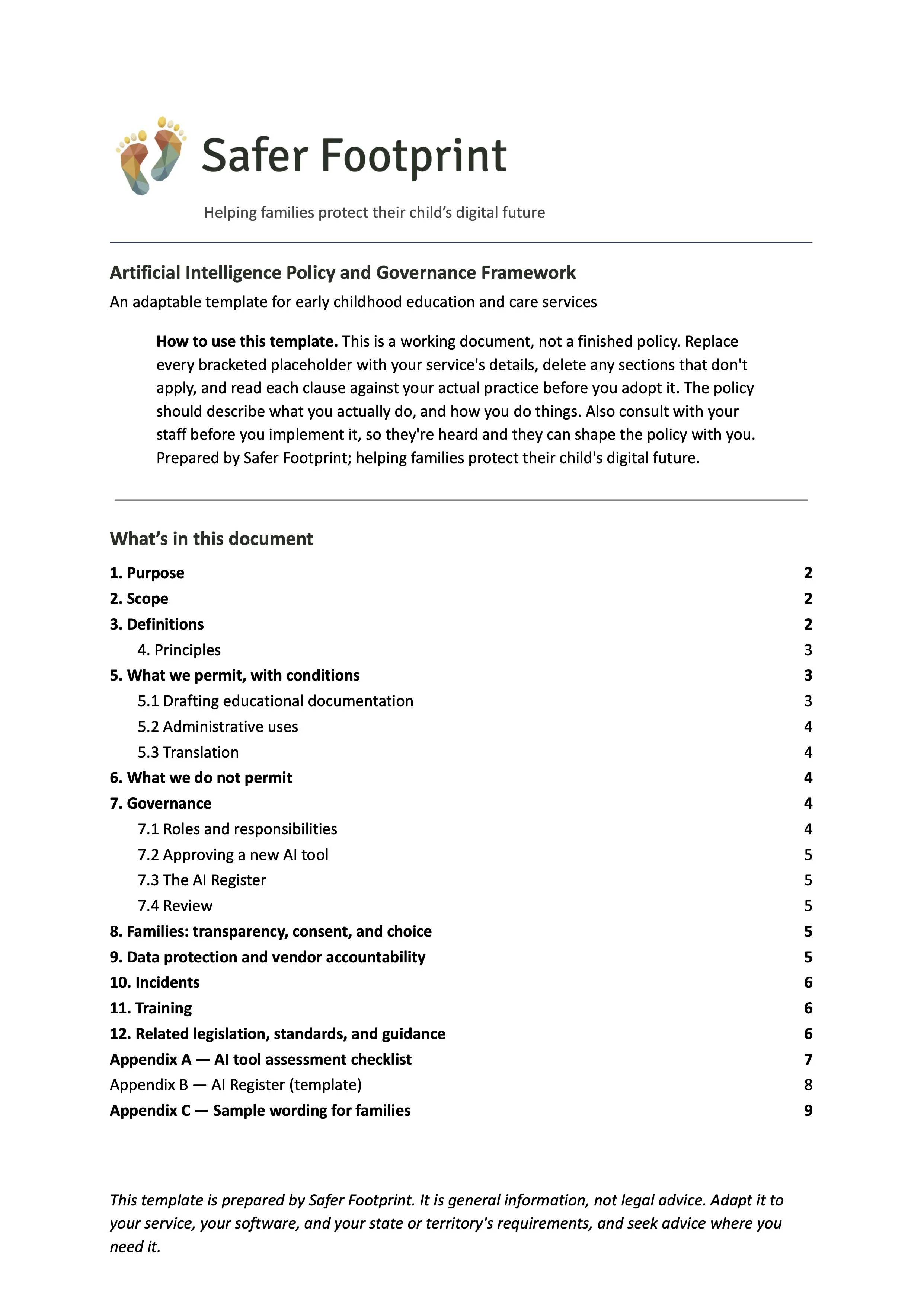
An adaptable template to govern the use of AI tools within early childhood education and care services
